
Managing Psychosocial Risk
60-minute self-paced online course. Practical training on the legal requirements for psychosocial risk management and the roles people across an organisation can play in supporting affected workers.
Workplace wellbeing training
Course fees and delivery options
Current course pricing and delivery information.
Course pricingCourse option
Contact us for a current quotation.
Delivery
Available by arrangement where stated.
Need help?
Contact the training team for current group pricing, delivery arrangements and booking support.
POA
Price — POA
Duration — See course information for duration.
Delivery — Delivery: Available by arrangement where stated.
Group delivery — Contact the training team for current group pricing, delivery arrangements and booking support.
Booking — See the course page for current availability.
Support — Contact the training team for current group pricing, delivery arrangements and booking support.
Contact the training team for current group pricing, delivery arrangements and booking support.
At a glance
Key information: About 60 minutes, 6 core topics and For all workers.

6 core topics
Legal requirements, hazard identification, controls, organisational roles, worker support and ethical considerations.
View topics
For all workers
Relevant from senior leadership through to entry-level staff; it does not train participants to act as counsellors.
Ask a question



Participants learn what psychosocial hazards are and how work design, demands, control, support, relationships and harmful behaviour can contribute to risk.
The course distinguishes a hazard from the risk of psychological or physical harm arising from exposure to psychosocial hazards.
The program reviews the WHS regulatory requirement to manage psychosocial risks through the risk-management process.
Participants consider consultation, reports, workplace data, observations and worker experience as sources of information about psychosocial hazards.
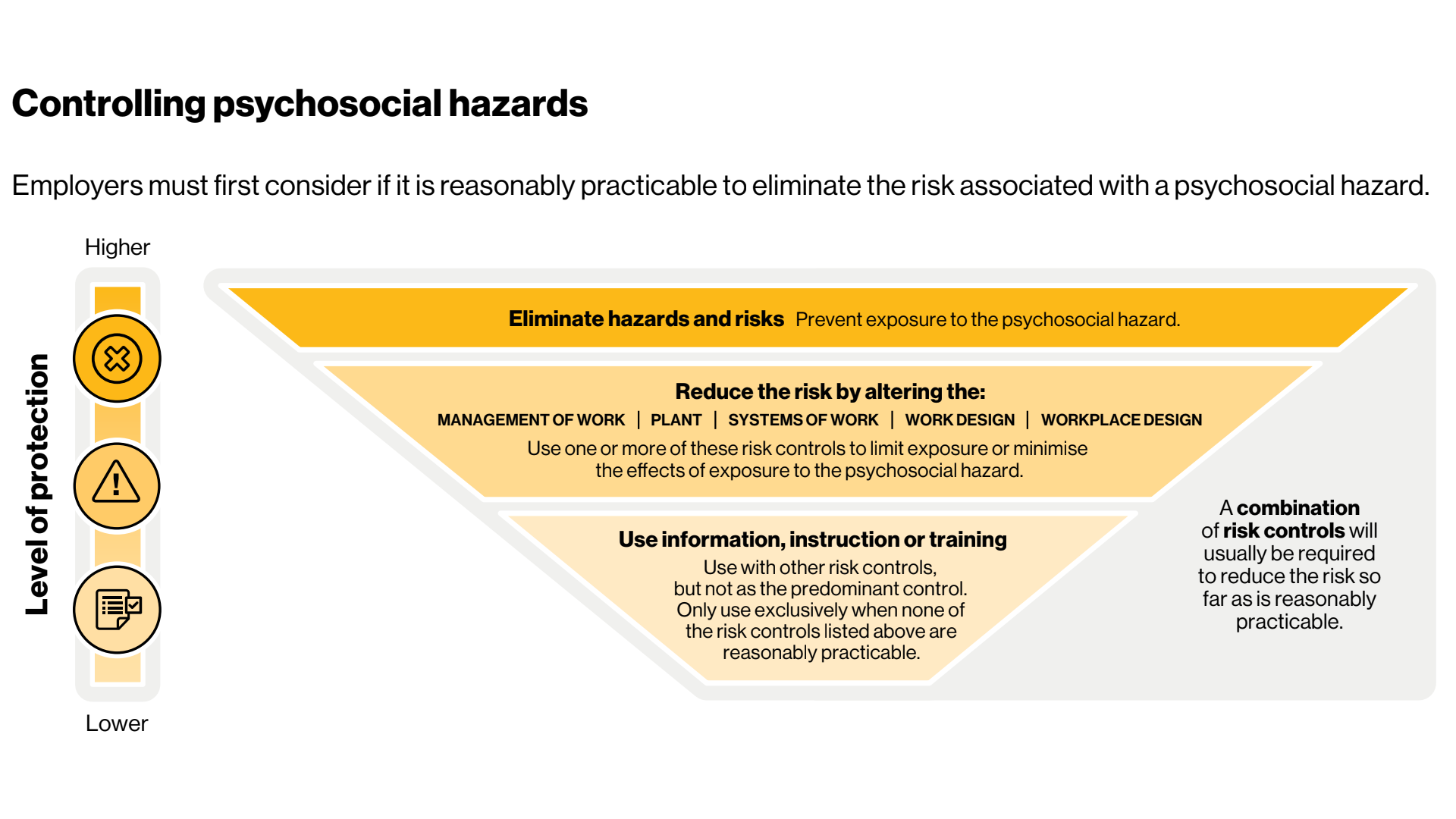
The hierarchy of controls and additional work-design tools are used to develop stronger organisational controls.
The course discusses how PCBUs, committees, HSRs, managers, supervisors and workers can contribute to psychosocial risk management.
Participants consider appropriate workplace responses and support pathways for people affected by psychosocial harm.
The course addresses confidentiality, respectful handling of sensitive information and other considerations when supporting affected workers.
Each topic uses an introductory video followed by text and a short knowledge check. The course is designed to take about 60 minutes.
A handbook is available after purchase and a certificate is available after the required course sessions are completed.
Managing Psychosocial Risk — course information — detailed information
This self-paced course focuses on the legal and practical management of psychosocial hazards and the roles different workplace parties can play in prevention and support. Participants also consider hazard identification, consultation, proportionate controls and ongoing review of psychosocial risks.
Detailed information
Overview
What to expect
Course topics
Training informationSix course topics presented together in one consistent section.

Managing Psychosocial Risk — course information — practical pathway
This self-paced course focuses on the legal and practical management of psychosocial hazards and the roles different workplace parties can play in prevention and support.
Review regulatory duties
Understand the current requirement to manage psychosocial hazards as part of workplace health and safety risk management.
Identify hazards
Consult workers and use workplace information to identify psychosocial hazards and patterns of exposure.
Assess exposure and risk
Consider frequency, duration, severity and interactions between hazards when understanding the risk of harm.
Prioritise work-design controls
Change work design, systems, workload, support, roles and organisational practices before relying only on individual coping measures.
Use workplace roles
Clarify how leaders, managers, HSRs, committees, supervisors and workers contribute to prevention and control.
Support affected workers
Respond respectfully, use appropriate support pathways and maintain suitable boundaries when workers report harm.
Consider legal and ethical issues
Handle sensitive information carefully and apply organisational processes consistently and respectfully.
Review controls
Monitor feedback, incidents, indicators and control performance and adjust controls when they are not effective.
Course format — Introductory video + text
Training informationEach course topic begins with an introductory video followed by supporting text.
Managing Psychosocial Risk — course information — FAQs
Detailed answers about course purpose, content, delivery and completion. Use the questions below to understand the information on this page, what it means in practice, where to find related details and what to do next. Review the linked information carefully, and contact the training team if you need clarification before making a booking, submitting an enquiry or taking the next step.
Frequently asked questionsA work-related factor that may cause psychological or physical harm, such as harmful demands, low control, poor support or harmful behaviour.
Risk reflects the likelihood and potential severity of harm arising from exposure to one or more psychosocial hazards.
Leaders, managers, supervisors, safety professionals, HSRs and others involved in workplace risk management can benefit.
The course is available 100% self-paced online.
The course is designed to be completed in about 60 minutes.
There is no formal assessment for this course. Short topic quizzes or knowledge checks are used through the learning content.
The course considers PCBUs, managers, supervisors, HSRs, committees, workers and support for affected people.
No. It focuses on workplace risk management and support roles, not clinical counselling or diagnosis.
Workers and HSRs can provide information about exposure, work design and whether proposed controls are practical and effective.
A course certificate can be downloaded after all required course sessions have been completed.
Yes. A course handbook can be downloaded after purchase.